What Is Copper Cable and What Types Are Available?
Copper Cable remains a practical foundation for Ethernet networks, telecommunications, security systems, and building automation. It carries signals through metal conductors, usually copper wires surrounded by insulation and protective layers. The design looks simple. The performance is not.
Andrew S. Tanenbaum, a respected computer-networking author and professor, explains, “The physical layer is concerned with transmitting raw bits over a communication channel.” That principle makes Copper Cable selection more important than its appearance. Twisted-pair cable reduces electromagnetic interference by pairing and twisting conductors. Unshielded twisted pair is common in offices. Shielded versions add protection near motors, power equipment, and industrial machinery. Coaxial cable uses a central conductor, dielectric insulation, metallic shielding, and an outer jacket. It remains useful for broadband, video, antennas, and specialized signal systems.
Solid copper conductors support stable permanent links. Stranded conductors bend more easily for patch cords and equipment connections. Category ratings, such as Cat5e, Cat6, and Cat6A, indicate tested transmission performance, but installation quality still matters. Poor termination can weaken an excellent cable. That detail is easy to overlook.
Standards, distance, temperature, bending radius, and connector compatibility should guide every choice. Field testers can verify continuity, insertion loss, return loss, and channel performance. Labels alone are not enough. A careful installer checks the actual environment.
There is no universal best type. Copper Cable can be affordable, durable, and easy to repair, yet it has distance and interference limits. A clear comparison helps readers choose realistically, not simply choose the newest category.
What Is Copper Cable and How Does It Transmit Signals?
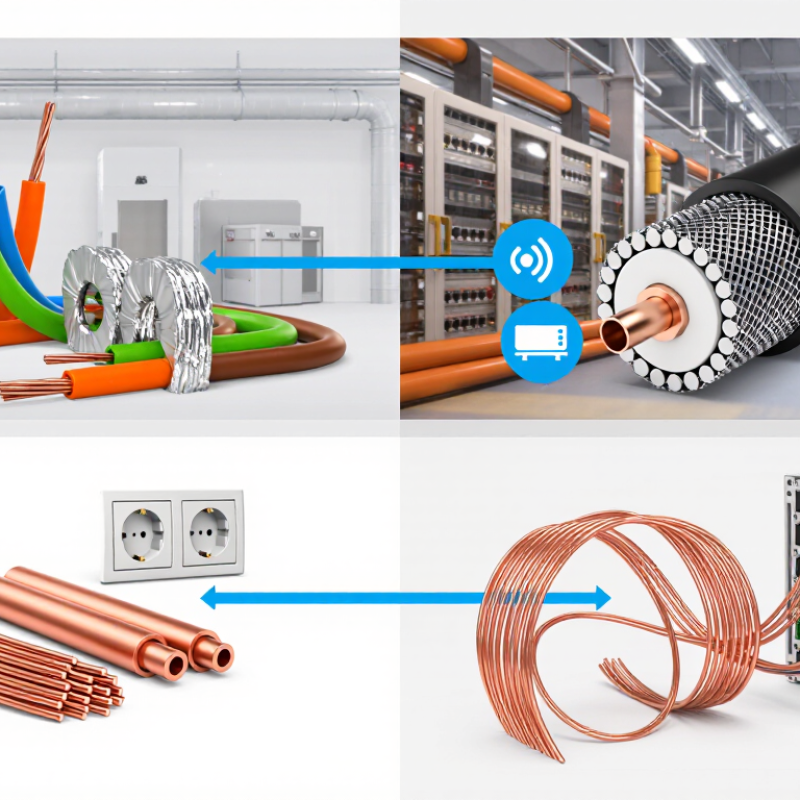
Copper cable carries information through electrical changes moving along a metal conductor. A transmitter converts data into controlled voltage or current patterns. The cable guides these patterns toward a receiver. The receiver then interprets them as digital data, audio, or other signals.
The copper core conducts the signal, while insulation keeps neighboring wires apart. In twisted-pair cable, two insulated conductors wrap around each other. This design reduces electromagnetic interference and limits signal leakage. Different twist rates can improve performance across multiple wire pairs. Unshielded versions suit many indoor networks, while shielded versions add protection in electrically noisy areas.
Coaxial cable uses a central copper conductor, insulation, a metallic shield, and an outer jacket. Its layered structure controls signal interference and supports stable transmission over longer distances. Other copper designs include parallel-pair and twinaxial cables, each suited to specific equipment and data conditions.
Distance matters.
As a signal travels, resistance weakens it and capacitance changes its shape. Higher frequencies usually lose more energy, so installation quality becomes important. Sharp bends, loose connectors, and excessive cable length can increase attenuation or reflections. In practice, I would inspect the route before selecting a cable type. A specification sheet may look convincing, but real walls, motors, and crowded cable trays can produce different results. Copper remains practical and measurable, although it is not perfect for every distance or bandwidth requirement.
What Is Copper Cable and What Types Are Available? - What Is Copper Cable and How Does It Transmit Signals?
| Copper Cable Type |
Basic Construction |
Typical Impedance |
How Signals Are Transmitted |
Common Applications |
Key Characteristics |
| Unshielded Twisted Pair (UTP) |
Pairs of insulated copper conductors twisted together without an overall metallic shield. |
Commonly about 100 Ω for balanced data cabling. |
Differential signaling sends opposite-polarity signals on each conductor, helping cancel external noise. |
Ethernet networks, telephone systems, building automation, and low-voltage control. |
Lightweight, flexible, cost-effective, and easy to terminate; more vulnerable to strong electromagnetic interference than shielded cable. |
| Shielded Twisted Pair (STP/FTP) |
Twisted copper pairs with foil, braid, or both around individual pairs and/or the entire cable. |
Commonly about 100 Ω for balanced data cabling. |
Balanced differential transmission is combined with shielding to reduce electromagnetic interference and crosstalk. |
Industrial networks, data centers, medical facilities, and areas with high electrical noise. |
Improved noise resistance; requires correct grounding and generally has greater diameter, weight, and installation complexity. |
| Coaxial Cable |
A central copper conductor, dielectric insulator, metallic shield, and protective outer jacket arranged concentrically. |
Common values include 50 Ω and 75 Ω, depending on the system. |
An unbalanced signal travels along the center conductor with the shield serving as the return path and electromagnetic barrier. |
Radio-frequency systems, antennas, video distribution, broadband access, and test equipment. |
Excellent shielding and controlled impedance; usually less flexible than twisted-pair cable. |
| Twinaxial Cable |
Two insulated inner copper conductors enclosed by a common dielectric and shield. |
Often designed around approximately 100 Ω for high-speed differential links. |
Differential signals travel over two balanced inner conductors while the outer shield limits interference. |
Short-reach data interconnects, computing equipment, instrumentation, and high-speed backplane connections. |
Low electromagnetic radiation and good high-frequency performance over short distances; less suitable for general-purpose building wiring. |
| Parallel or Ribbon Cable |
Multiple insulated copper conductors arranged side by side in a flat or grouped format. |
Impedance varies with conductor spacing, insulation, and geometry; it is not normally specified as one universal value. |
Signals use separate conductors, often with dedicated ground or return conductors. |
Internal equipment wiring, control panels, printers, embedded systems, and legacy computer interfaces. |
Simple and economical for short internal connections; crosstalk and signal skew can increase as speed and length rise. |
| Single-Conductor Wire |
One solid or stranded copper conductor with insulation or an exposed conductive surface. |
No fixed characteristic impedance in ordinary power or point-to-point wiring. |
Carries voltage or current between a source and load; signal quality depends strongly on the return path and surrounding environment. |
Grounding, power distribution, control circuits, breadboards, and short internal connections. |
Available in solid or stranded forms; easy to use, but generally offers less protection against noise than paired or shielded cable. |
How copper cable transmits signals:
Electrical signals travel through copper as changes in voltage and current. The copper conductor provides a low-resistance path, while cable geometry, insulation, twisting, shielding, and impedance control influence attenuation, crosstalk, electromagnetic interference, and maximum usable frequency.
Main Types of Copper Cable and Their Construction
Copper cable uses copper conductors to carry electrical power or data. Its construction affects flexibility, signal quality, heat control, and installation safety. In field work, the conductor’s size matters as much as the cable type.
Solid-core cable contains one copper wire per conductor. It offers stable electrical performance and works well in fixed installations. However, repeated bending can damage it. Stranded cable uses many thin copper wires twisted together. It bends easily and suits patch leads, machinery, and moving equipment. The trade-off is slightly higher electrical resistance.
Twisted-pair cable contains two insulated conductors wound around each other. This design reduces electromagnetic interference and supports reliable data transmission. Unshielded versions are lighter and easier to install, while shielded versions add a metal foil or braid around the pairs. That extra layer helps in electrically noisy areas, but poor grounding can reduce its benefit. Coaxial cable has a central copper conductor, dielectric insulation, a conductive shield, and an outer jacket. Its layered construction controls signal loss and protects against interference. Different cable jackets also matter; indoor PVC and outdoor-rated materials do not perform equally under sunlight or moisture. In my experience, installers sometimes focus on conductor material and overlook bend radius. That mistake can weaken a cable before testing begins. No cable is perfect. Selection should match the load, environment, distance, and movement involved.
Key Differences Between Twisted-Pair and Coaxial Cable
What Is Copper Cable and What Types Are Available?
Key Differences Between Twisted-Pair and Coaxial Cable
Copper cable carries electrical signals through metal conductors. The two common designs are twisted-pair and coaxial cable. Twisted-pair cable contains insulated copper wires twisted around each other. This structure reduces electromagnetic interference between circuits. It supports Ethernet, telephone, and building automation systems. According to ANSI/TIA-568.2-D, a balanced twisted-pair channel can reach 100 meters, including permanent links and patch cords. In practice, crowded cable trays, sharp bends, and poor terminations can reduce performance. I have seen a short cable run fail because its connector was installed carelessly. The standard does not remove human error.
Coaxial cable uses a central copper conductor, insulation, a metallic shield, and an outer jacket. Its shield provides stronger protection against external noise. Many broadband and video systems use 75-ohm coaxial designs. By contrast, twisted-pair usually uses balanced signaling and requires careful pair management. The ISO/IEC 11801 structured-cabling standard supports both copper media choices for different communication environments. Coaxial cable can perform well over longer distances, but attenuation increases with frequency and cable length. Twisted-pair is lighter and easier to route. Neither option is automatically superior.
Tips: Check the required distance, bandwidth, impedance, and noise conditions before buying cable. Keep twisted pairs untwisted for the shortest possible length. Avoid tight bends and excessive pulling force. Test installed links with certified field equipment. A lower-cost cable may become expensive after repeated troubleshooting.
Common Applications of Copper Cable in Modern Networks
What Is Copper Cable and What Types Are Available?
Copper cable carries electrical signals through copper conductors. In modern networks, twisted-pair cable is the most common type. Categories such as Cat5e, Cat6, and Cat6A support different speeds and bandwidth levels. Shielded versions can reduce interference near motors, lighting systems, and power equipment. Coaxial cable remains useful for broadband distribution, video systems, and some specialized connections.
Twisted-pair copper supports office Ethernet, connecting computers, access points, printers, and network switches. Power over Ethernet can send data and electrical power through one cable. This helps operate security cameras, door controllers, wireless access points, and digital phones. A ceiling-mounted access point may need only one cable, which simplifies installation and maintenance. Most horizontal Ethernet links are designed for distances up to 100 meters, including patch connections.
Copper also serves homes, schools, factories, and small data rooms. Industrial networks may use rugged, shielded cable where vibration and electrical noise are serious concerns. Coaxial cable can connect antennas, broadband equipment, and monitoring displays. During field installations, cable routing often matters as much as cable category. Sharp bends, excessive pulling force, and poor termination can weaken performance.
Specifications alone do not guarantee a reliable link. That assumption can fail. An advanced cable may perform poorly beside unshielded power wiring. Installers should test completed runs, label both ends, and leave reasonable service slack. Copper is not always the newest option, but its familiar tools and straightforward maintenance remain valuable.
Factors to Consider When Choosing a Copper Cable
Copper cable carries electrical signals or power through copper conductors. Common types include twisted-pair, coaxial, solid-core, and stranded cable. Choose by performance, not appearance.
For Ethernet, ANSI/TIA-568.2-E guidance commonly uses a 100-metre channel limit. Category 6A is usually better for 10 Gb/s over that distance.
Shielding can reduce interference near motors or fluorescent lighting. However, poor grounding can weaken that benefit.
The installation environment matters just as much. Outdoor runs need moisture resistance and ultraviolet protection. Plenum spaces require suitable fire-performance ratings. Flexible stranded cable suits patching, while solid conductors suit permanent runs.
Do not ignore conductor quality. Copper-clad aluminium cable may cost less, but its resistance and termination behavior differ. Test reports should identify conductor material, gauge, impedance, attenuation, and temperature rating.
The International Energy Agency’s Global Critical Minerals Outlook 2024 reports that announced projects could cover only 70% of projected 2035 copper demand. That figure makes material efficiency more than a purchasing preference.
IEEE 802.3bt also permits up to 90 watts from the power source for higher-power Ethernet applications. I sometimes over-specify cables for short, quiet runs. A site survey and certification test can prevent that mistake.



 +86 13777722188
 WHATSAPP
 PHONE
PHONE E-MAIL